
Is Your Boss Reading Your Work Chats? The Legal Limits of Remote Monitoring at Work

Table of Contents
Imagine you're at work, chatting with a colleague on Teams or Slack, when suddenly you wonder: 'Is my boss reading all this?' It's not just paranoia: remote monitoring is real, but it has precise limits. In this article, we explain what your employer can and cannot do, and how to defend yourself without becoming paranoid.
The Trap of Remote Monitoring: When the Boss Becomes 'All-Seeing'
Remote monitoring of employees is an increasingly common practice, especially with smart working. But beware: not everything is allowed. Italian law (Workers' Statute, Article 4) states that employers can install monitoring systems only for organizational, production, or security needs, and only after agreement with unions or authorization from the Labor Inspectorate.
The problem is that many employers interpret this rule broadly, monitoring work chats, emails, activity time, and even mouse movements. But if they do so without following the rules, they risk heavy penalties and privacy violations.
When Is Monitoring Legal?
Monitoring is legal only if:
- It is justified by real needs (e.g., IT security, productivity)
- It has been clearly communicated to employees (via company policy or union agreement)
- It does not violate the worker's dignity and confidentiality
For example, a company can monitor network traffic to prevent cyberattacks, but it cannot systematically read every private message between colleagues.
The Risks for You: What You Risk If Monitoring Is Abusive
If your boss reads your work chats without complying with the law, you risk unpleasant consequences: disciplinary dismissal based on illegally collected evidence, privacy violations, and even reputational damage. But the good news is that you can defend yourself.
How to Defend Yourself: Your Rights
Here's what you can do:
- Ask for the company policy: every company must have a clear policy on monitoring. If it doesn't, that's a red flag.
- Use personal chats for private matters: avoid discussing sensitive topics on corporate channels. Use WhatsApp or Signal for personal issues.
- Report abuses: if you suspect illegal monitoring, contact the Data Protection Authority or a union.
And remember: the law protects you. The employer cannot use illegally collected evidence to sanction you.
Featured Snippet: What Are the Limits of Remote Monitoring at Work?
The limits of remote monitoring are established by Article 4 of the Workers' Statute and the GDPR. The employer can only monitor for organizational, production, or security needs, and only after informing employees and obtaining the necessary authorizations. They cannot read private chats or personal emails without a valid reason. In case of violation, the worker can claim damages and request the nullity of the collected evidence.
In Italy, protection is strong, but not perfect. Compared to the American model, where the California CCPA and CPRA offer similar protections but with a focus on transparency and the right to access data, Italian regulations are more restrictive for employers. The California CCPA, for example, requires companies to inform consumers (including workers) about what data is collected and for what purposes, while in Italy explicit consent is often necessary. This means that if you work for an American company based in California, you may have additional rights compared to an Italian worker, but in both cases, abusive monitoring is prohibited.
Frequently Asked Questions (FAQ)
Can my boss read my chats on Teams or Slack?
Yes, but only if the company has a clear policy and the monitoring is justified by organizational or security needs. They cannot do it out of curiosity or to arbitrarily check your productivity.
What should I do if I discover my boss is illegally monitoring my chats?
Gather evidence (screenshots, emails), contact a union or the Data Protection Authority. You can also claim damages for privacy violations.
Is remote monitoring legal in smart working?
Yes, but with the same rules: it must be communicated, justified, and proportionate. You cannot be monitored 24/7 with webcams or spy software without your consent.
Now that you know your rights, don't get caught off guard. With NakedPact, you can create a customized confidentiality pact to protect your privacy at work. Start now and sleep soundly.
📊 How Widespread Is Remote Monitoring?
Source: estimate based on 2023-2024 data (North America and Europe). Monitoring is more common in tech companies and smart working.
The widget shows estimated percentages of remote monitoring of employees, based on industry research. The data highlights how monitoring of work chats (67%) and activity time (82%) are the most common practices, while the use of webcams or spy software is less widespread (12%) but still present. These statistics help contextualize the risk: if you work in a tech company or in smart working, you are likely being monitored in some form. The widget is designed to be visually clear and immediate, with colors indicating the level of prevalence (from green for the most common to red for the least common).

NakedPact Editorial Committee
Article created by the NakedPact editorial team. Our mission is to analyze, simplify, and expose unfair terms and hidden risks in everyday contracts to protect citizens and consumers.
Sources and Legal References
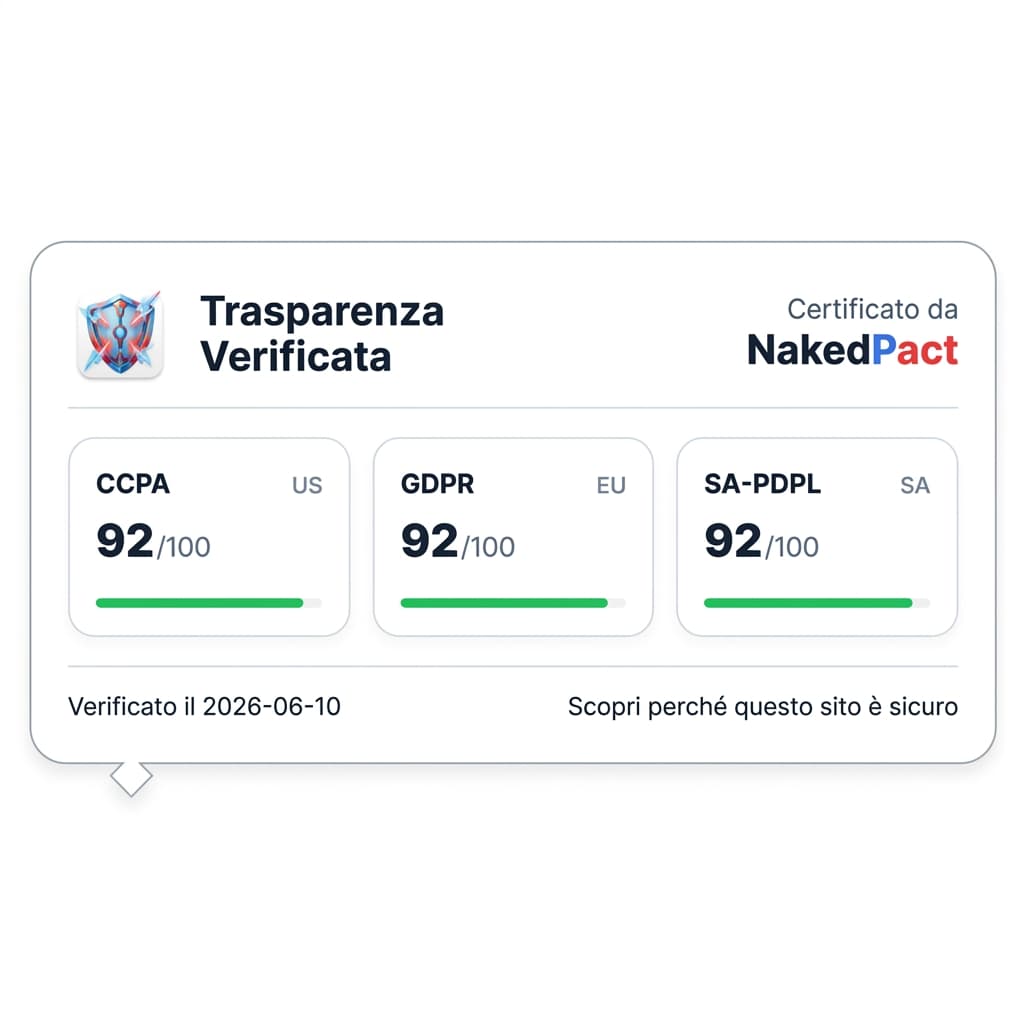
Do you own a website?
Want to communicate your data processing transparency to your users? Dynamically use our badge and showcase your platform's compliance.
Recommended Readings


🛡️ Protect your rights with one click
Don't risk signing abusive clauses. Install the free NakedPact extension for Chrome or Firefox and instantly analyze any contract on the web.
Don't trust, verify.
Now that you know the risks, don't sign blindly. Upload your contract to NakedPact and let AI find the hidden clauses for you. It's 100% free.
Analyze Your Contract Now